
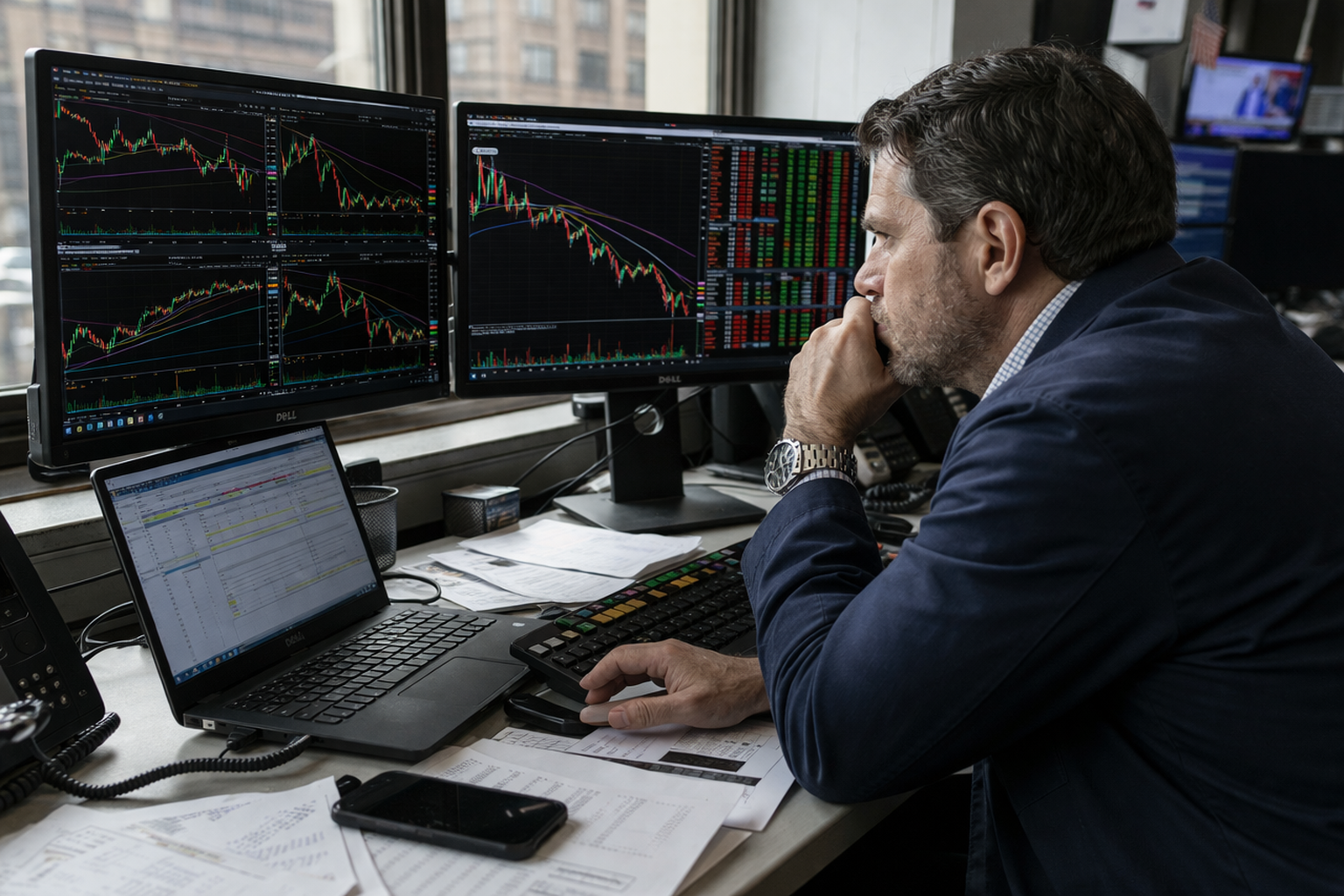
US investment advisers are warning clients of a broadening set of risks heading into the second quarter, citing hotter inflation, mounting geopolitical tensions and emerging strains in the private credit market, after the S&P 500 posted its worst quarterly performance since 2022, Reuters reported.
The index fell 4.6% in the first quarter, ending a period marked by policy uncertainty and market volatility.
The 10-year Treasury yield climbed to 4.44%, while gold suffered a 13% decline in March — its steepest monthly fall since October 2008.
The simultaneous weakness in both equities and fixed income rattled confidence in conventional portfolio construction.
Policy uncertainty rattles markets more than bad news
Advisers say the market’s difficulty stems less from the economic data itself than from the absence of clear policy direction.
“Markets can handle bad news,” said Mark Stancato, managing director and wealth adviser at VIP Wealth Advisors in Decatur, Georgia.
What the markets can’t handle is a lack of clarity around policy and goals.
Jim Carroll, senior wealth adviser and fixed income specialist at Ballast Rock Private Wealth in Charleston, South Carolina, said clients remained focused on the overseas conflict and its long-term implications, the future trajectory of oil prices, and the influence of private capital flows on public markets.
“The markets were quite bouncy throughout the day, but overall had an orderly decline and were able to recover most of the loss by the end of the quarter,” he said.
Simultaneous stock and bond weakness tests the 60/40 model
The concurrent decline in equities and government bonds during the first quarter has exposed the limitations of the 60/40 portfolio approach that investors have relied upon for decades, according to Jon Ulin, founder of Ulin & Co Wealth Management in Boca Raton, Florida.
The dynamic is significant because the traditional model assumes that bonds rise when stocks fall, providing a natural hedge.
That relationship broke down during the quarter, leaving diversified portfolios with few places to shelter.
“This is one of the toughest economic and market situations I have ever seen,” said Lisa Kirchenbauer, president and founder of Omega Wealth Management in Arlington, Virginia.
Stagflation risk and the outlook for spending
Some advisers are warning that the combination of high energy prices and supply chain disruption could push the economy toward stagflation.
David Haas, president and portfolio manager at Cereus Financial Advisors in Franklin Lakes, New Jersey, said he expects inflation to exceed 4%, with recession risk rising owing to elevated oil prices and persistent supply chain inefficiencies.
High-net-worth families are expected to reduce spending over the coming months as the cumulative weight of market losses, energy costs and geopolitical uncertainty takes hold.
Client anxiety and the limits of reassurance
Advisers report that sustained market volatility is beginning to exhaust clients emotionally as much as financially.
Kirchenbauer said she senses that many people are “numb, overwhelmed, petrified,” with some no longer returning calls.
The shift in client sentiment reflects a broader change in how investors are approaching risk. Rather than applying a single framework across asset classes, many are now scrutinising individual holdings more closely as certain long-held assumptions about diversification and safe havens come under pressure.
What advisers are watching in Q2?
Heading into the second quarter, advisers say their focus will be on inflation readings, energy price movements, geopolitical developments, and conditions in the private credit market.
The potential impact of artificial intelligence on productivity and consumer spending power is also emerging as a discussion point with clients, alongside the risk that a protracted period of high oil prices tips the economy into a more severe slowdown.
The post S&P 500 worst quarter since 2022 puts 60/40 portfolios under stress appeared first on Invezz
