
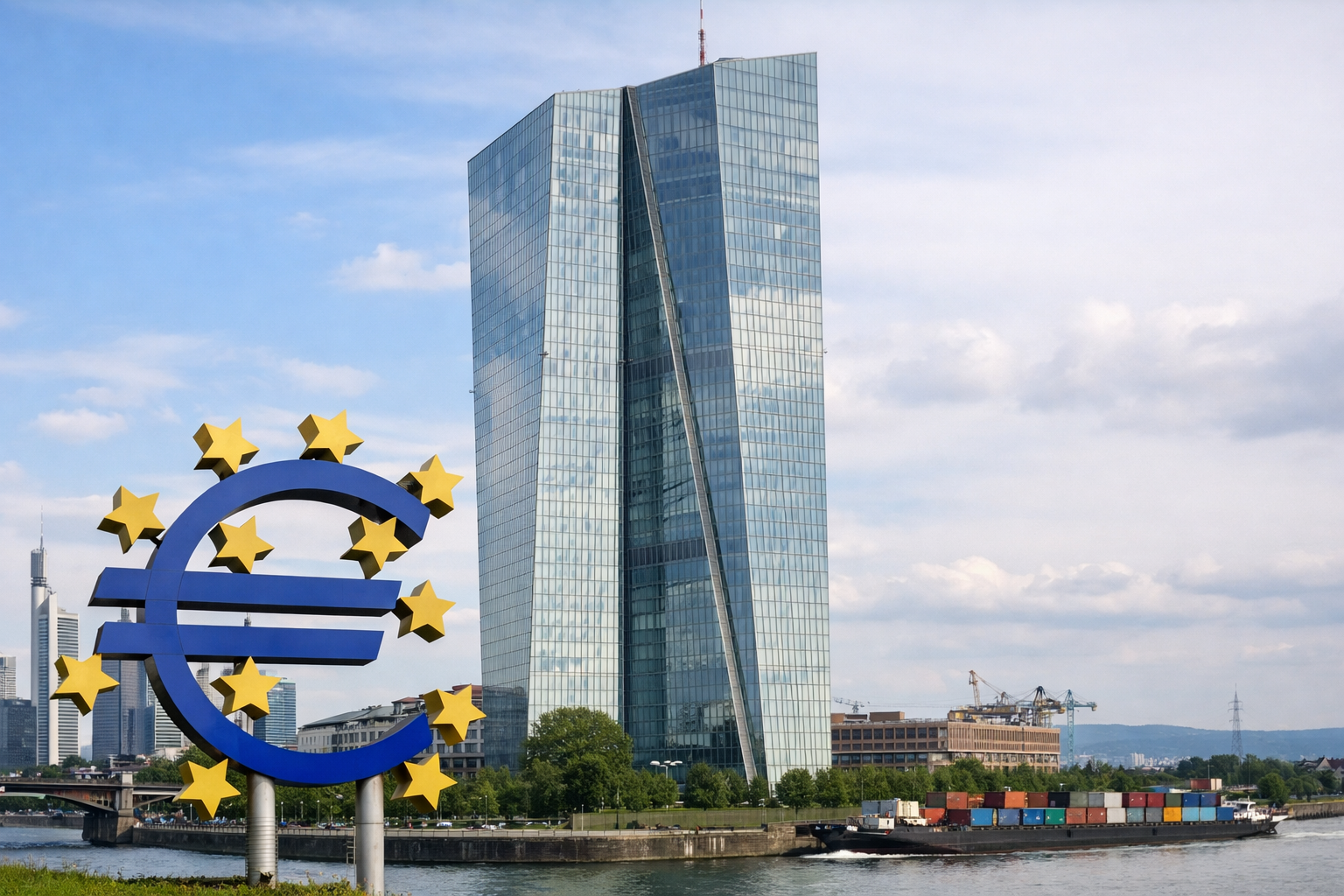
The European Central Bank (ECB) kept interest rates unchanged on Thursday, signalling confidence that inflation will stabilise over time even as recent data show price pressures easing.
The decision, which was widely anticipated by markets, reflects a cautious approach shaped as much by global uncertainty as by domestic economic trends.
Policymakers left their core policy settings intact, emphasising that the current inflation slowdown does not alter the central bank’s medium-term assessment.
While price growth has dipped below target, the ECB continues to see inflation converging towards its goal as underlying demand remains resilient.
Inflation slips but policy stance holds
Inflation across the 21 countries that share the euro slowed to 1.7% last month, its lowest level since September 2024.
Forecasts suggest that price growth could remain slightly below the ECB’s 2% target for at least the next year, driven by easing energy prices and softer momentum in some goods categories.
Despite this, the ECB reiterated that inflation should stabilise at its target in the medium term.
Policymakers signalled that short-term deviations from the goal are not enough to justify a change in direction, particularly while inflation expectations remain broadly anchored.
Rates unchanged across the board
The ECB left the deposit rate at 2%, where it has stood since June.
Other key rates were also unchanged, with the rate on main refinancing operations held at 2.15% and the marginal lending facility rate maintained at 2.40%.
By keeping its full rate structure steady, the ECB reinforced its message of patience.
The decision suggests policymakers are comfortable allowing time for earlier tightening to continue working through the economy rather than responding immediately to recent inflation data.
Eurozone economy shows resilience
The central bank described the eurozone economy as resilient despite a challenging global environment.
It highlighted low unemployment, relatively strong private sector balance sheets, and the gradual rollout of public spending on defence and infrastructure as key supports.
Economic activity has shown signs of improvement, with consumption and investment picking up in the final three months of 2025.
This momentum has helped offset concerns about weaker external demand and has given the ECB greater confidence in the economy’s ability to absorb higher borrowing costs.
Global uncertainty dominates the backdrop
While domestic conditions have stabilised, the ECB warned that global risks remain elevated.
Recent developments have underscored this uncertainty, including a sharp fall in the US dollar and renewed volatility in commodity markets.
Political tensions have also added to the fragile backdrop.
The Trump administration’s disputes over Greenland and its pressure on the Federal Reserve to cut rates have highlighted how quickly the global policy environment can shift, with potential spillovers for Europe.
These factors continue to weigh heavily on the ECB’s assessment, reinforcing its cautious stance even as inflation cools.
With the rate decision delivered, attention now turns to the press conference by ECB President Christine Lagarde, scheduled to begin at 1345 GMT.
Investors will be watching closely for further clarity on how policymakers balance softer inflation against persistent global risks, and for signals on how long rates are likely to remain at current levels.
The post ECB holds rates steady as global risks overshadow easing inflation appeared first on Invezz
