
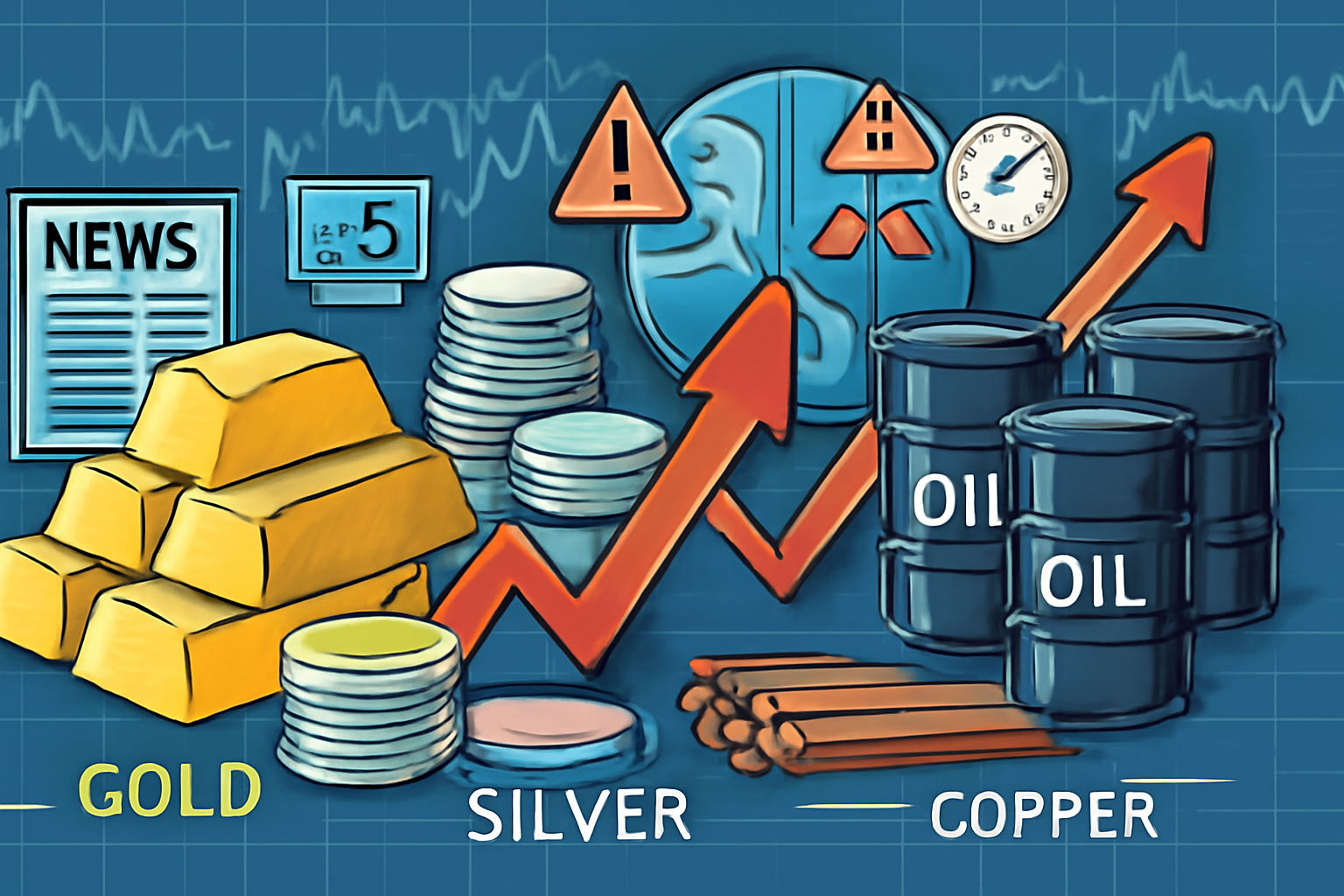
Gold prices pared losses from earlier in the day as softer-than-expected US inflation data raised hopes of Federal Reserve rate cuts next year.
Silver prices fell sharply as investors booked profits after the metal had hit record highs above $66 per ounce.
Meanwhile, oil prices rose as concerns about lower supply boosted sentiments among investors.
Additionally, base metal prices also climbed on anticipation over further interest rate cuts by the US Fed in 2026.
Gold steady
While gold’s price is supported by the expectation of eventual interest rate cuts and persistent macroeconomic uncertainty, its high valuation and large existing inventories of above-ground gold suggest a more cautious strategy for taking on additional risk.
US consumer prices in November increased by 2.7% year-on-year, according to recently released data.
This figure was lower than the 3.1% rise that economists surveyed by Reuters had predicted.
Following the release of this data, futures on the federal funds rate indicated a marginally higher probability that the Federal Reserve will cut interest rates during its January meeting.
“Gold may need a longer period of consolidation, possibly at lower levels, for the MACD to pull back and reset to levels from which a substantial rally can begin,” said David Morrison, senior market analyst at Trade Nation.
At the time of writing, the COMEX gold contract was at $4,368.80 per ounce, largely unchanged from the previous close.
Meanwhile, silver prices on COMEX were 1.8% lower at $65.693 per ounce.
“Could traders finally be wary of pushing prices up further? Or is this simply a much-needed breath-taking pause after silver’s terrific rally?,” Morrison said.
Either interpretation is possible, but which is more likely? At the risk of sounding like a scratched record (remember them?), the daily MACD is significantly overbought. That would suggest approaching silver with great caution, whether a bull or a bear.
Oil rises
Oil prices rose on Thursday as investors assessed the potential for more US sanctions targeting Russia, and supply concerns stemming from a blockade of Venezuelan oil tankers.
The US intends to impose a blockade on sanctioned oil tankers travelling to and from Venezuela, a move announced by President Trump that has raised concerns about the future of Venezuelan oil exports.
“This puts at risk around 600k b/d of oil exports, the majority of which goes to China,” Warren Patterson, head of commodities strategy at ING Group, said in a note.
“However, flows to the US, currently around 160k b/d (160,000 barrels per day), will likely continue.
Chevron, which previously obtained a license from the US government to continue its operations in Venezuela, is the source of this oil.
“The key questions are, first, how effective this blockade will be, and second, how long it will last. This will be important in determining the impact on the oil market,” Patterson said.
Supply risk in the market is heightened following Wednesday’s reports that the US government is planning to impose even more stringent sanctions on Russia’s energy sector.
This increased risk is dependent on President Putin not reaching a peace agreement with Ukraine.
Patterson said:
Given the surplus outlook and Brent trading around $60/bbl, Trump has room to be more aggressive with sanctions.
Base metals
Base metal trading is characterised by caution this morning, driven by a blend of uncertain global macro indicators, a stable dollar following its recent rally, and market-specific news affecting key sectors.
Fragile risk sentiment, stemming from the recent volatility in US tech stocks, is directing traders’ attention towards upcoming inflation figures and central bank statements, according to Neil Welsh, head of metals at FCA-regulated multi-asset brokerage Britannia Global Markets.
Despite pulling back from last week’s record high, copper prices remain historically elevated.
This sustained level follows a one-third rally this year, fueled by mine disruptions, strong demand, and the continuing narrative around the energy transition.
Welsh said:
The recent retreat alongside a modestly firmer dollar and weaker risk appetite in equities highlights how sensitive the metal (copper) remains to short term macro swings even as structural fundamentals stay tight.
Aluminium and zinc are currently declining, mirroring the trend in copper. However, technical support levels remain relevant, especially following zinc’s recent recovery from critical price points.
At the time of writing, the three-month copper contract on the London Metal Exchange was at $11,764.15 per ton, up 0.3% from the previous close. The aluminium contract was $2,914.75 per ton, up 0.4%.
The post Commodity wrap: gold steady on rate cut hopes, oil rises on sanction fears appeared first on Invezz
